the patient who got gaslit
“15K Later and I Still Can’t Tie My Shoes”
AKA
The Patient Who Got Gaslit
Mary K spent 10 years and $15,000 just trying to tie her shoes without pain.
A decade ago, after crushing it all season on the tennis court, Mary began to experience nagging pain in the front of her shoulder. Her journey, which is not unlike many patients who seek out dry needling, brought her to the following practitioners:
Three orthopedic physicians
Two Physiatrists
Five physical therapists, 2 of whom were dry needlers
One acupuncturist
Two chiropractors
Three massage therapists
One occupational therapist
One Rolfer
A medicine man energy worker in Sedona
From what she could remember, over the past decade she’d been diagnosed with:
Supraspinatus tendinitis
Bicipital tendinitis
Rotator Cuff tendinitis
Thoracic Outlet Syndrome
Cervical Radiculopathy
AC joint dysfunction
Carpal tunnel syndrome
Fibromyalgia
Tennis elbow
A blocked heart chakra
Her lists of treatments/procedures through the years included:
Trigger point dry needling
Cumulative years of physical therapy
Months of occupational therapy
EMG/nerve conduction
Nerve ablations
Cortisone injections
Hydro dissection
Cervical adjustments
PRP therapy
Laser therapy
Past life regression
Mary kept a journal and was very specific with her complaints. Ten years ago her pain began in the anterior shoulder. As the years progressed, she suffered anterior shoulder pain, and posterior shoulder, forearm and hand pain. Lately, just the extensor forearm and hand hurt and tingled all the time. Gripping things was tough. Tennis was no longer an issue, because she stopped playing it due to pain five years ago. Reaching for and fastening a seatbelt while on the passengers side was excruciating, as was tying her shoe on the opposite side of her body.
Over the past year she developed an intolerance to bright lights and loud noises and felt like everything aggravated her. She began to think “maybe this all is in my head,” which is what one of her orthopedic physicians told her after imaging was negative.
From what I could gather from the interview (and Mary pointing “they always went here, here, and here with dry needles”) it appeared the following muscles were addressed during her years of on-off dry needling sessions:
Anterior deltoid
Biceps
Supraspinatus
Infraspinatus
Cervical Multifidi
Pec Major
Triceps
Wrist extensors
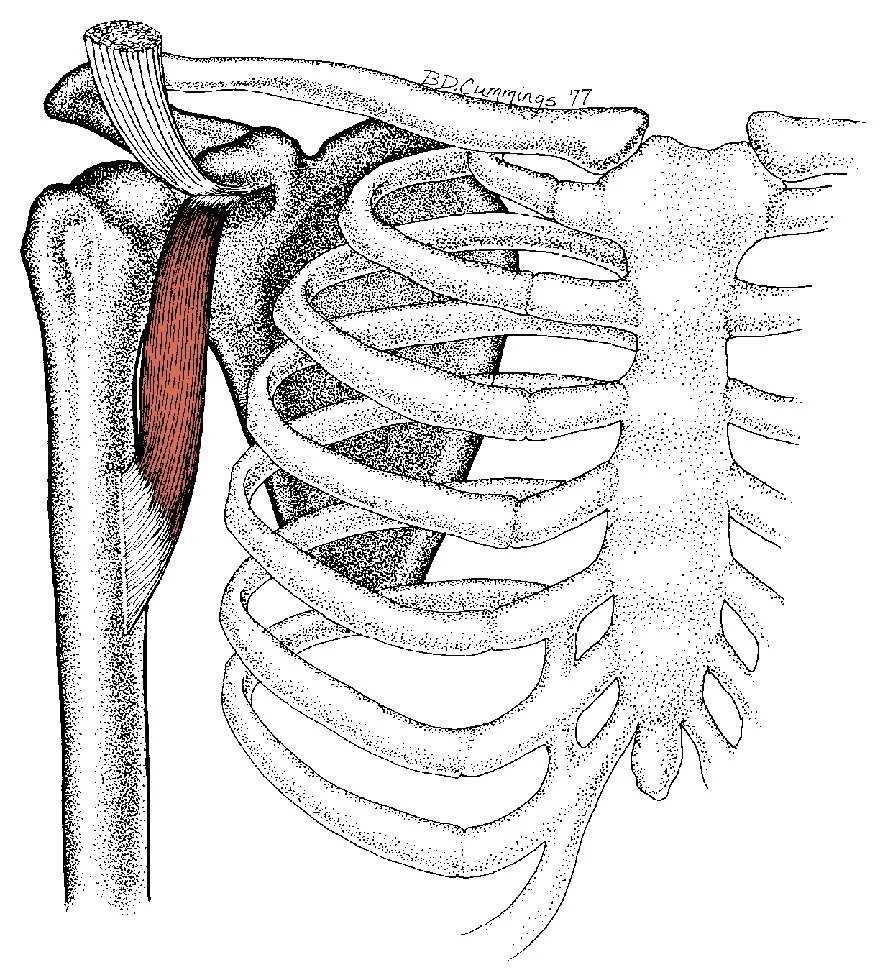
Although previous practitioners did their due diligence, the corocobrachialis seemed untouched by treatment.
Often referred to as the “forgotten” muscle, the coracobrachialis can be stressed by things like prolonged slouching (think office workers with poor posture, or kids looking at their cell phones all day), repetitive overhead movements (think tennis and swimming), pushing and pulling (think pull ups and bench press, or that epic “team-building” tug-of-war event).
Why do some clinicians forget this muscle? For one thing, it’s puny. Our minds tend to gravitate towards looking at the larger, primary drivers of shoulder flexion and shoulder adduction, whereas the coracobrachialis is more like an actor playing a supporting role.
After one session of thoroughly needling the coracobrachialis (along with some synergists) Mary no longer experienced tingling in her forearm and hand. After two sessions, she was clicking a seat belt and tying her opposite shoe without pain, and made a tennis “play date” with her best friend.
Dry needling is only as effective as the clinician’s knowledge of the body. At New Moon Physiotherapy, I have over 30 years experience in diagnosing and treating myofacial pain, and I strive to figure out the cause of your problems, rather than just addressing your symptoms. Sadly, many of my patients come to me after undergoing months, years or even decades of physical therapy and health care procedures that never addressed the problem. Let’s fix the paradigm. I can’t wait to meet you!
Noelle Schlegel, PT, DPT, Cert-DN, CMTPT/DN, RYT